|
 |
 |
|
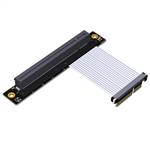
PCIe 3.0 x8 Male to x4 Female Down R/A Extension Cable The PCIe 3.0 x8 Male to x4 Female Down R/A Extension Cable is a specialized passive interconnect solution engineered for space-constrained systems requiring adaptive connectivity between different PCIe slot sizes while maintaining PCIe 3.0 compliance. This cable converts a larger PCIe x8 slot interface into a smaller PCIe x4 interface, supporting a data transfer rate of 8.0 GT/s per lane and delivering a total bandwidth of approximately 3.94 GB/s for the x4 configuration, with backward compatibility to PCIe 2.0/1.0 devices . The design incorporates a Down Right-Angle (Down R/A) female connector that optimizes spatial efficiency by directing the cable downward relative to the motherboard plane, reducing mechanical obstruction in low-clearance environments such as 1U/2U servers or compact workstations . Constructed with impedance-controlled wiring (targeting 85-ohm differential) and multi-layer shielding, this cable minimizes signal degradation while addressing mechanical routing challenges in dense configurations . The passive design addresses both form-factor adaptation and cable routing needs, making it ideal for test benches, data centers, and custom systems where flexible card placement is critical. Features - Form Factor Adaptation: Enables physical and electrical compatibility between PCIe x8 and x4 interfaces, allowing x4 devices (e.g., NVMe SSDs or network controllers) to be installed in x8 slots while operating at x4 lane speeds .
- Down Right-Angle Connector Optimization: The Down R/A female connector directs the cable downward relative to the motherboard plane, minimizing vertical profile and preventing interference with adjacent components (e.g., GPUs or cooling systems) in low-profile chassis .
- PCIe 3.0 Compliance: Supports PCIe 3.0 specifications with a data transfer rate of 8.0 GT/s per lane, providing a bandwidth of approximately 3.94 GB/s for the x4 interface .
- Enhanced Signal Integrity: Utilizes multi-layer shielding (e.g., foil and braid) to minimize insertion loss, crosstalk, and electromagnetic interference (EMI), ensuring stable performance in high-frequency environments .
- Passive Design: Requires no external power or active components, relying on high-quality copper conductors and precise impedance control for reliable operation .
- Durable Construction: Incorporates robust materials such as shielded connectors and reinforced housings, rated for numerous insertion cycles in commercial or development environments .
Specifications - Product Model: PCIe 3.0 x8 Male to x4 Female Down R/A Extension Cable
- Connector A: PCIe 3.0 x8, Male, Edge Connector
- Connector B: PCIe 3.0 x4, Female, Down Right-Angle (Down R/A)
- Cable Type: Passive Copper Extension Assembly
- Pinout Configuration: PCIe-compliant, mapping x8 host interface to x4 device lanes
- Data Rate Support: Up to 8.0 GT/s (PCIe 3.0)
- Supported Protocols: PCI Express 3.0/2.0/1.0
- Impedance: 85 ohms differential (target, aligned with PCIe 3.0 standards)
- Cable Length: Standard options: 0.25m, 0.5m (custom lengths up to 1.0m available; longer lengths require validation)
- Wire Gauge: 30–34 AWG (typical for PCIe 3.0 applications)
- Shielding: Foil and braid for EMI protection
- Operating Temperature: -20°C to +80°C (commercial grade)
- Durability: Minimum 500 insertion cycles
- Safety Standards: RoHS compliant
Applications - High-Density Servers: Deploying in rack-mounted systems (e.g., 1U/2U configurations) where the Down R/A design optimizes cable routing in cramped spaces for x4 add-on cards (e.g., NICs or controllers) installed in x8 slots .
- Test and Development Benches: Facilitating hardware validation and signal integrity analysis of x4 devices in multi-slot environments, enabling debugging or compatibility testing .
- Compact Workstations: Enabling flexible component placement in small-form-factor builds where motherboard x4 slots are obstructed by larger components like GPUs or cooling systems .
- Mining Rigs or Computational Setups: Supporting multiple PCIe devices in dense configurations where lane-count flexibility and efficient cable routing are critical .
|
|
|
 |
|
 |
|